7.2 原对偶内点法
这个 notebook 与第7章第2部分“原对偶内点法”对应。为了让代码尽量直接,我们先看一个一维线性规划例子,再看一个 100 维线性规划例子,并直接实现原对偶牛顿方向。
本例重点观察:
原对偶残差 和中心残差 ;
牛顿方向如何同时更新原变量 和对偶乘子 ;
线搜索如何保持严格可行性和 ;
代理对偶间隙 如何趋近于 0;
高维 LP 例子中的迭代次数和运行时间。
import time

import numpy as np
import matplotlib.pyplot as plt

from IPython.display import HTML, display

plt.rcParams["font.sans-serif"] = [
    "Arial Unicode MS",
    "PingFang SC",
    "Heiti TC",
    "Microsoft YaHei",
    "SimHei",
]
plt.rcParams["axes.unicode_minus"] = False

print_large = lambda text: display(HTML(f'<font size="3">{text}</font>'))
def f_constraints(x):
    return np.array([1.0 - x, x - 2.0])


def df_constraints(x):
    return np.array([-1.0, 1.0])


def objective(x):
    return x


x_star = 1.0
p_star = objective(x_star)
m = 2

print_large(f"原问题最优解 x* = {x_star:.1f}")
print_large(f"原问题最优值 p* = {p_star:.1f}")
print_large(f"点 x=1.5 的约束值 f(x) = {f_constraints(1.5)}")
Loading...
Loading...
Loading...
def residual(x, lam, t):
    r_dual = np.array([1.0 + df_constraints(x) @ lam])
    r_cent = -lam * f_constraints(x) - np.ones(m) / t
    return np.concatenate([r_dual, r_cent])


def surrogate_gap(x, lam):
    return -f_constraints(x) @ lam


def is_strictly_feasible(x, lam):
    return np.all(f_constraints(x) < 0) and np.all(lam > 0)
def primal_dual_direction(x, lam, t):
    f = f_constraints(x)
    df = df_constraints(x)
    r = residual(x, lam, t)

    jacobian = np.zeros((3, 3))
    jacobian[0, 1:] = df
    jacobian[1:, 0] = -lam * df
    jacobian[1:, 1:] = np.diag(-f)

    step = np.linalg.solve(jacobian, -r)
    dx = step[0]
    dlam = step[1:]
    return dx, dlam
mu = 10.0
alpha = 0.01
beta = 0.5
eps = 1.0e-8
eps_feas = 1.0e-8
max_iter = 50

x = 1.5
lam = np.array([1.0, 1.0])
history = []

for k in range(max_iter):
    eta = surrogate_gap(x, lam)
    r_dual_norm = abs(1.0 + df_constraints(x) @ lam)
    history.append([k, x, lam[0], lam[1], eta, r_dual_norm])

    if eta <= eps and r_dual_norm <= eps_feas:
        break

    t = mu * m / eta
    dx, dlam = primal_dual_direction(x, lam, t)
    residual_norm = np.linalg.norm(residual(x, lam, t))

    step_size = 1.0
    while not is_strictly_feasible(x + step_size * dx, lam + step_size * dlam):
        step_size *= beta

    while (
        np.linalg.norm(residual(x + step_size * dx, lam + step_size * dlam, t))
        > (1.0 - alpha * step_size) * residual_norm
    ):
        step_size *= beta

    x = x + step_size * dx
    lam = lam + step_size * dlam

history = np.array(history)

print(" k        x          lambda1      lambda2       eta        |r_dual|")
for row in history:
    print(
        f"{int(row[0]):2d}  {row[1]:10.6f}  {row[2]:10.6f}  "
        f"{row[3]:10.6f}  {row[4]:9.2e}  {row[5]:9.2e}"
    )

print_large(f"最终 x = {x:.10f}")
print_large(f"最终 lambda = {np.round(lam, 10)}")
print_large(f"最终代理对偶间隙 = {surrogate_gap(x, lam):.3e}")
 k        x          lambda1      lambda2       eta        |r_dual|
 0    1.500000    1.000000    1.000000   1.00e+00   1.00e+00
 1    1.375000    0.800000    0.300000   4.88e-01   5.00e-01
 2    1.188648    0.830051    0.080051   2.22e-01   2.50e-01
 3    1.082513    0.911380    0.036380   1.09e-01   1.25e-01
 4    1.040107    0.956967    0.019467   5.71e-02   6.25e-02
 5    1.001087    1.002181    0.002181   3.27e-03   0.00e+00
 6    1.000165    1.000162    0.000162   3.27e-04   2.22e-16
 7    1.000016    1.000016    0.000016   3.27e-05   1.11e-16
 8    1.000002    1.000002    0.000002   3.27e-06   0.00e+00
 9    1.000000    1.000000    0.000000   3.27e-07   0.00e+00
10    1.000000    1.000000    0.000000   3.27e-08   0.00e+00
11    1.000000    1.000000    0.000000   3.27e-09   0.00e+00
Loading...
Loading...
Loading...
plt.figure(figsize=(11, 3.0))

plt.subplot(1, 3, 1)
plt.plot(history[:, 0], history[:, 1], "o-")
plt.axhline(x_star, color="black", linestyle="--", label=r"$x^*=1$")
plt.xlabel("迭代步数", fontsize=12)
plt.ylabel(r"$x$", fontsize=12)
plt.title("原变量", fontsize=14)
plt.grid(alpha=0.25)
plt.legend()

plt.subplot(1, 3, 2)
plt.plot(history[:, 0], history[:, 2], "o-", label=r"$\lambda_1$")
plt.plot(history[:, 0], history[:, 3], "s-", label=r"$\lambda_2$")
plt.xlabel("迭代步数", fontsize=12)
plt.title("对偶乘子", fontsize=14)
plt.grid(alpha=0.25)
plt.legend()

plt.subplot(1, 3, 3)
plt.plot(history[:, 0], history[:, 4], "o-", label=r"$\hat\eta$")
plt.plot(history[:, 0], history[:, 5], "s-", label=r"$|r_{dual}|$")
plt.yscale("log")
plt.xlabel("迭代步数", fontsize=12)
plt.title("残差与代理间隙", fontsize=14)
plt.grid(alpha=0.25)
plt.legend()

plt.tight_layout()
plt.show()
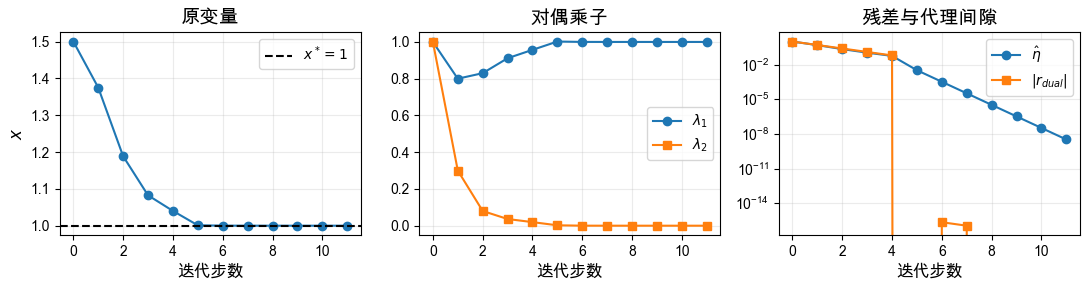
观察结果:
从严格可行点 1.5 逐渐靠近边界最优解 ,但每一步仍保持 。
最优点处第一个约束 是活跃约束,因此 靠近 1;第二个约束 不活跃,因此 靠近 0。
代理对偶间隙 持续下降,说明扰动 KKT 条件逐渐接近原问题的 KKT 条件。
np.random.seed(7)

n_large = 100
c_large = 0.5 + np.random.rand(n_large)
D_large = np.vstack([-np.eye(n_large), np.eye(n_large)])
m_large = 2 * n_large

def lp100_constraints(x):
    return np.concatenate([-x, x - 1.0])

def lp100_objective(x):
    return c_large @ x

def lp100_residual(x, lam, t):
    r_dual = c_large + D_large.T @ lam
    r_cent = -lam * lp100_constraints(x) - np.ones(m_large) / t
    return np.concatenate([r_dual, r_cent])

def lp100_surrogate_gap(x, lam):
    return -lp100_constraints(x) @ lam

def lp100_is_strictly_feasible(x, lam):
    return np.all(lp100_constraints(x) < 0) and np.all(lam > 0)

def lp100_direction(x, lam, t):
    f = lp100_constraints(x)
    residual_value = lp100_residual(x, lam, t)
    jacobian = np.block([
        [np.zeros((n_large, n_large)), D_large.T],
        [-np.diag(lam) @ D_large, -np.diag(f)],
    ])
    step = np.linalg.solve(jacobian, -residual_value)
    return step[:n_large], step[n_large:]
x_large = 0.5 * np.ones(n_large)
lam_large = np.ones(m_large)
history_large = []

start_time = time.perf_counter()

for k in range(max_iter):
    eta = lp100_surrogate_gap(x_large, lam_large)
    r_dual_norm = np.linalg.norm(c_large + D_large.T @ lam_large)
    history_large.append([
        k,
        lp100_objective(x_large),
        eta,
        r_dual_norm,
        np.linalg.norm(x_large),
    ])

    if eta <= eps and r_dual_norm <= eps_feas:
        break

    t = mu * m_large / eta
    dx, dlam = lp100_direction(x_large, lam_large, t)
    residual_norm = np.linalg.norm(lp100_residual(x_large, lam_large, t))

    step_size = 1.0
    while not lp100_is_strictly_feasible(
        x_large + step_size * dx,
        lam_large + step_size * dlam,
    ):
        step_size *= beta

    while (
        np.linalg.norm(
            lp100_residual(
                x_large + step_size * dx,
                lam_large + step_size * dlam,
                t,
            )
        )
        > (1.0 - alpha * step_size) * residual_norm
    ):
        step_size *= beta

    x_large = x_large + step_size * dx
    lam_large = lam_large + step_size * dlam

runtime = time.perf_counter() - start_time
history_large = np.array(history_large)

print_large(f"维度 n = {n_large}, 不等式约束个数 m = {m_large}")
print_large(f"迭代步数 = {len(history_large) - 1}")
print_large(f"运行时间 = {runtime * 1000:.2f} ms")
print_large(f"最终目标函数值 = {lp100_objective(x_large):.3e}")
print_large(f"最终代理对偶间隙 = {lp100_surrogate_gap(x_large, lam_large):.3e}")
print_large(f"最终 dual residual = {np.linalg.norm(c_large + D_large.T @ lam_large):.3e}")
Loading...
Loading...
Loading...
Loading...
Loading...
Loading...
plt.figure(figsize=(10, 3.4))

plt.subplot(1, 2, 1)
plt.plot(history_large[:, 0], history_large[:, 1], "o-", label=r"$c^T x$")
plt.plot(history_large[:, 0], history_large[:, 4], "s-", label=r"$\|x\|_2$")
plt.yscale("log")
plt.xlabel("迭代步数", fontsize=12)
plt.title("原变量靠近最优解", fontsize=14)
plt.grid(alpha=0.25)
plt.legend()

plt.subplot(1, 2, 2)
plt.plot(history_large[:, 0], history_large[:, 2], "o-", label=r"$\hat\eta$")
plt.plot(history_large[:, 0], history_large[:, 3], "s-", label=r"$\|r_{dual}\|_2$")
plt.yscale("log")
plt.xlabel("迭代步数", fontsize=12)
plt.title("残差与代理间隙", fontsize=14)
plt.grid(alpha=0.25)
plt.legend()

plt.tight_layout()
plt.show()
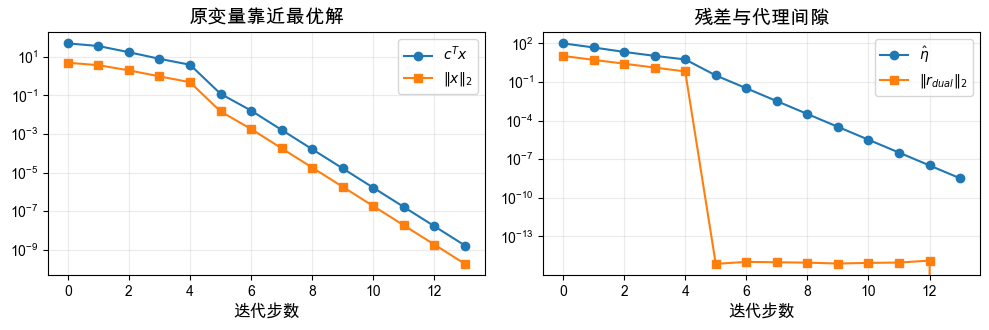
观察结果:
这个 100 维例子仍然使用同一套原对偶残差和牛顿线性化,只是把一维变量换成了向量。
因为所有 ,最优解在下边界 上,图中 和目标函数值都逐步下降。
运行时间包含每一步构造并求解一个 的线性方程组。
总结
这个 notebook 用一个一维例子和一个 100 维 LP 例子展示了原对偶内点法的核心结构:
用 检查驻点条件;
用 检查扰动互补关系;
通过牛顿系统同时更新 和 ;
用线搜索保持严格可行性与正乘子;
在较高维例子中,可以用运行时间观察线性方程组求解带来的计算成本。